Boao (James) Chen
Ph.D. Researcher

👋
Hi there! I am a PhD student at the Michtom School of Computer Science, Brandeis University, working under the mentorship of Prof.Subhadeep Sarkar. My research interest are broadly in tuning and optimizing large scale data systems, with a current focus on Log-Structured Merge (LSM) trees. Prior to joining Brandeis, I completed my undergraduate studies in Computer Science from Cornell University.
No news so far...
2026
- In ReviewMind the Buffer: Dissecting the LSM-Buffer Design SpaceBoao Chen, Shubham Kaushik, and Subhadeep Sarkar2026
Log-structured merge (LSM)-trees are widely used as the storage layer data structure in modern NoSQL key-value stores due to their superior ingestion throughput, competitive query performance, and efficient space utilization. To enable fast ingestion, LSM-based storage engines first batch the incoming data in an in-memory buffer and then, opportunistically write the data to slower secondary storage as a collection of immutable sorted runs. We point out that while the data is largely storage-resident, the overall performance of an LSM-based storage engine is critically bottlenecked by the (i) implementation, (ii) tuning, and (iii) size of the in-memory buffer. In fact, even with the same buffer configuration, the performance of an LSM-engine may vary by several orders of magnitude if there is a shift in workload. Choosing the appropriate buffer design, thus, is crucial for performance, but, at the same time, hard, as the LSM-buffer design space is vast and largely unexplored. In this paper, we evaluate and analyze the performance of LSM-engines with nine different buffer implementations – including three hash-hybrid designs – while varying the tuning and size for each implementation to understand their implications on performance and the tradeoffs associated. For each configuration, we further vary the workload composition and distribution, the LSM-tuning, and the underlying hardware to quantify their impact on performance. To the best of our knowledge, this is the first comprehensive analysis of LSM-buffer design space. Finally, for the practitioners, we present a handbook with 10 key guidelines for choosing the appropriate buffer design and tuning for a given workload and performance target.
2025
- TPCTC
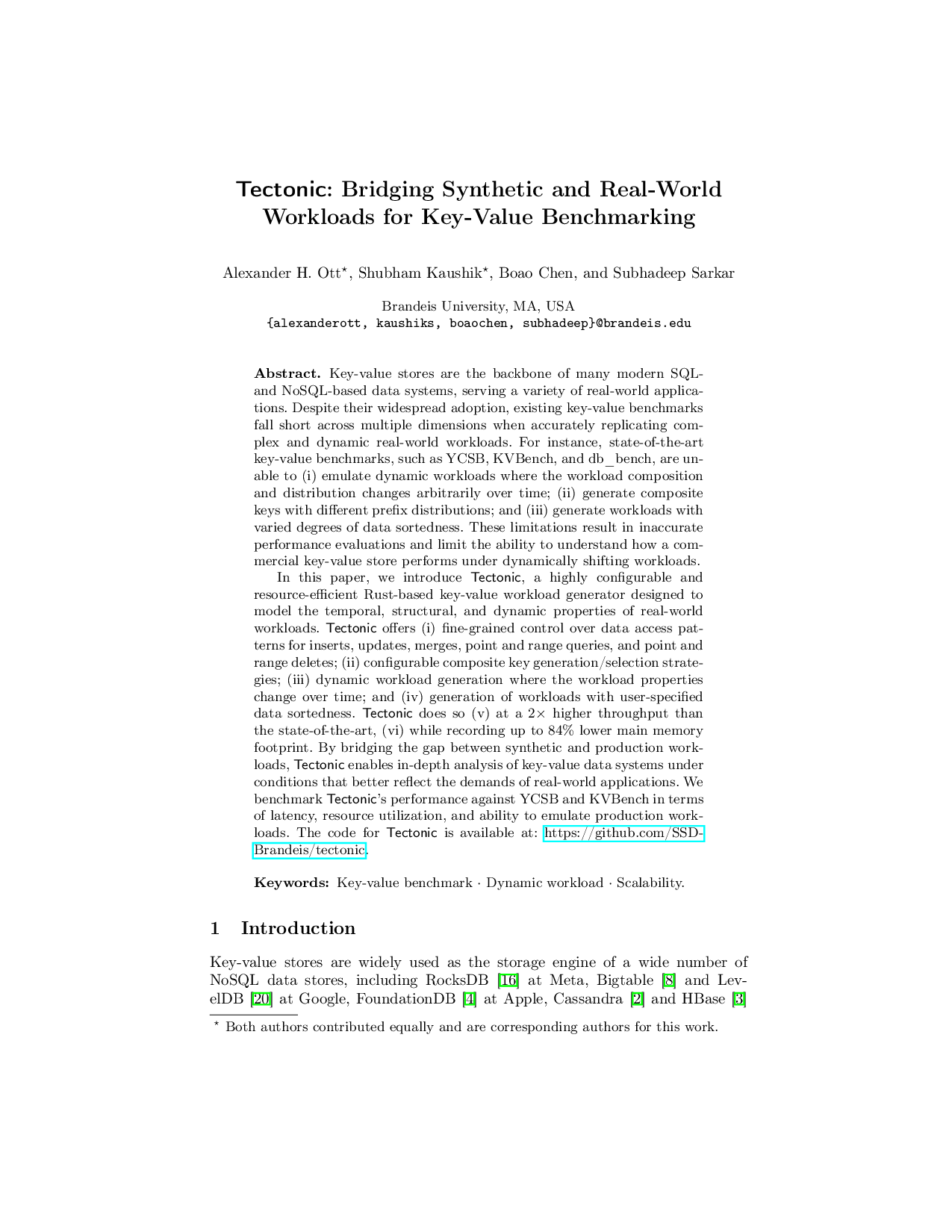 Alexander H. Ott, Shubham Kaushik, Boao Chen, and Subhadeep Sarkar2025
Key-value stores are the backbone of many modern SQL- and NoSQL-based data systems, serving a variety of real-world applications. Despite their widespread adoption, existing key-value benchmarks fall short across multiple dimensions when accurately replicating complex and dynamic real-world workloads. For instance, state-of-the-art key-value benchmarks, such as YCSB, KVBench, and db_bench, are unable to (i) emulate dynamic workloads where the workload composition and distribution changes arbitrarily over time; (ii) generate composite keys with different prefix distributions; and (iii) generate workloads with varied degrees of data sortedness. These limitations result in inaccurate performance evaluations and limit the ability to understand how a commercial key-value store performs under dynamically shifting workloads. In this paper, we introduce Tectonic, a highly configurable and resource-efficient Rust-based key-value workload generator designed to model the temporal, structural, and dynamic properties of real-world workloads. Tectonic offers (i) fine-grained control over data access patterns for inserts, updates, merges, point and range queries, and point and range deletes; (ii) configurable composite key generation/selection strategies; (iii) dynamic workload generation where the workload properties change over time; and (iv) generation of workloads with user-specified data sortedness. Tectonic does so (v) at a 2x higher throughput than the state-of-the-art, (vi) while recording up to 84% lower main memory footprint. By bridging the gap between synthetic and production workloads, Tectonic enables in-depth analysis of key-value data systems under conditions that better reflect the demands of real-world applications. We benchmark Tectonic’s performance against YCSB and KVBench in terms of latency, resource utilization, and ability to emulate production workloads. The code for Tectonic is available at: https://github.com/SSD-Brandeis/tectonic.

2024
- CHI
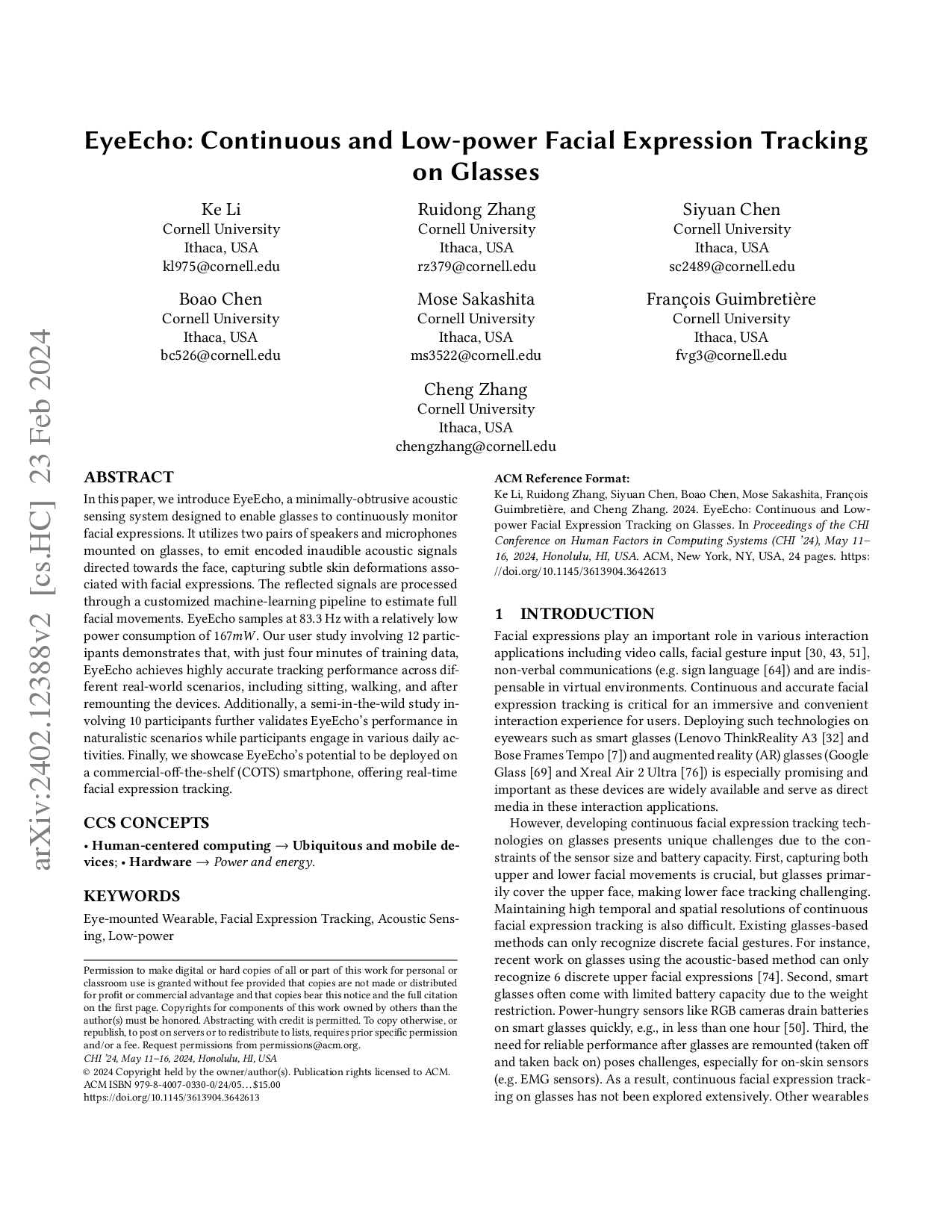 Ke Li, Ruidong Zhang, Siyuan Chen, Boao Chen, Mose Sakashita, François Guimbretière, and Cheng Zhang2024
In this paper, we introduce EyeEcho, a minimally-obtrusive acoustic sensing system designed to enable glasses to continuously monitor facial expressions. It utilizes two pairs of speakers and microphones mounted on glasses, to emit encoded inaudible acoustic signals directed towards the face, capturing subtle skin deformations associated with facial expressions. The reflected signals are processed through a customized machine-learning pipeline to estimate full facial movements. EyeEcho samples at 83.3 Hz with a relatively low power consumption of 167 mW. Our user study involving 12 participants demonstrates that, with just four minutes of training data, EyeEcho achieves highly accurate tracking performance across different real-world scenarios, including sitting, walking, and after remounting the devices. Additionally, a semi-in-the-wild study involving 10 participants further validates EyeEcho’s performance in naturalistic scenarios while participants engage in various daily activities. Finally, we showcase EyeEcho’s potential to be deployed on a commercial-off-the-shelf (COTS) smartphone, offering real-time facial expression tracking.
- MobiCom
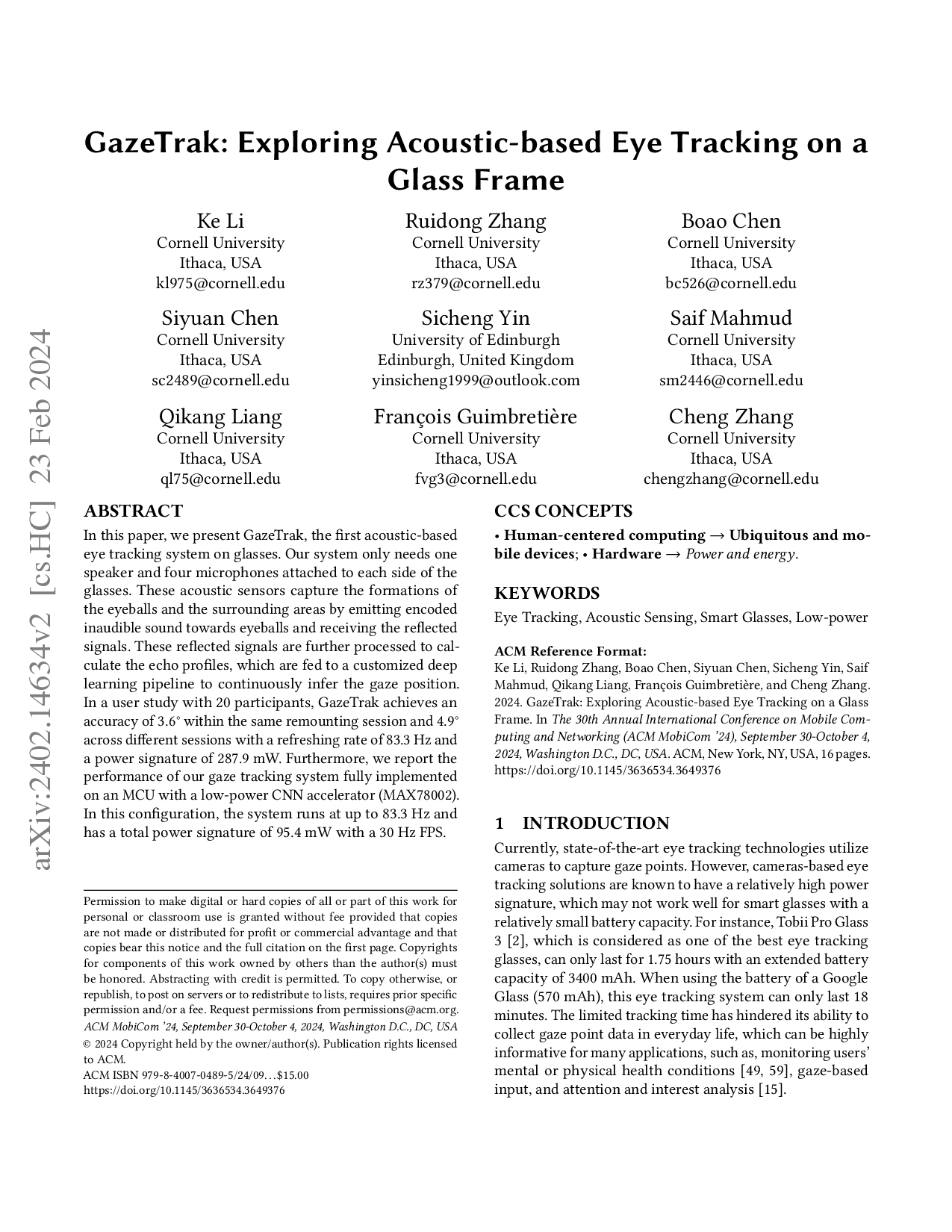 Ke Li, Ruidong Zhang, Boao Chen, Siyuan Chen, Sicheng Yin, Saif Mahmud, Qikang Liang, François Guimbretière, and Cheng Zhang2024
In this paper, we present GazeTrak, the first acoustic-based eye tracking system on glasses. Our system only needs one speaker and four microphones attached to each side of the glasses. These acoustic sensors capture the formations of the eyeballs and the surrounding areas by emitting encoded inaudible sound towards eyeballs and receiving the reflected signals. These reflected signals are further processed to calculate the echo profiles, which are fed to a customized deep learning pipeline to continuously infer the gaze position. In a user study with 20 participants, GazeTrak achieves an accuracy of 3.6° within the same remounting session and 4.9° across different sessions with a refreshing rate of 83.3 Hz and a power signature of 287.9 mW. Furthermore, we report the performance of our gaze tracking system fully implemented on an MCU with a low-power CNN accelerator (MAX78002). In this configuration, the system runs at up to 83.3 Hz and has a total power signature of 95.4 mW with a 30 Hz FPS.
- IMWUT
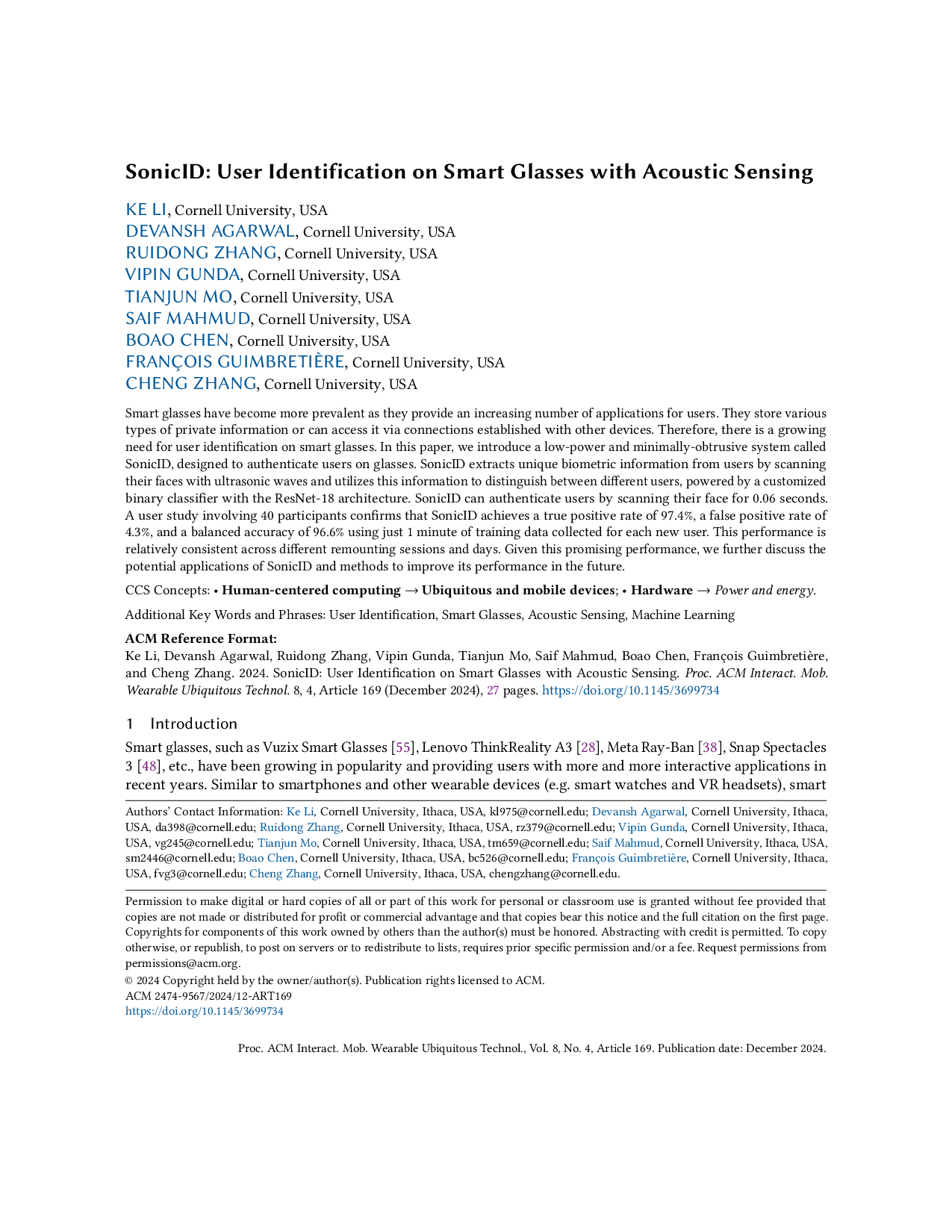 Ke Li, Devansh Agarwal, Ruidong Zhang, Vipin Gunda, Tianjun Mo, Saif Mahmud, Boao Chen, François Guimbretière, and Cheng Zhang2024
Smart glasses have become more prevalent as they provide an increasing number of applications for users. They store various types of private information or can access it via connections established with other devices. Therefore, there is a growing need for user identification on smart glasses. In this paper, we introduce a low-power and minimally-obtrusive system called SonicID, designed to authenticate users on glasses. SonicID extracts unique biometric information from users by scanning their faces with ultrasonic waves and utilizes this information to distinguish between different users, powered by a customized binary classifier with the ResNet-18 architecture. SonicID can authenticate users by scanning their face for 0.06 seconds. A user study involving 40 participants confirms that SonicID achieves a true positive rate of 97.4%, a false positive rate of 4.3%, and a balanced accuracy of 96.6% using just 1 minute of training data collected for each new user. This performance is relatively consistent across different remounting sessions and days. Given this promising performance, we further discuss the potential applications of SonicID and methods to improve its performance in the future.


